Venture Concept to
Investor-Ready Launch
Architected a scalable, high-trust platform for children's clothing rental — from strategic validation through technical build, supply chain security, and organic community growth to full investor readiness.
.png)
High-friction model.
Zero-to-traction build.
kidswr. was a subscription-based children's clothing rental platform — a genuinely high-friction business model requiring simultaneous trust-building with consumers, supply chain relationships with premium brands, and investor-grade infrastructure, all from zero.
The mandate was to move beyond an MVP and architect a scalable, high-trust ecosystem: prove the model was viable for modern parents, secure the supply chain before launch, and demonstrate organic traction strong enough to anchor an investor pitch without paid advertising.
"A complete foundational build — custom technology, high-trust brand, data-driven organic growth, and secured supplier relationships. Positioned as an investor-ready disruptor in a category it helped define."
Solve the trust deficit
before building anything.
Children's clothing rental carries an inherent trust problem: hygiene concerns, convenience skepticism, and the question of whether rotating inventory delivers real value for families. Before a single line of code was written, those objections had to be understood and designed around.
Deep-dive consumer research and focus groups surfaced the exact friction points, then informed every brand, UX, and messaging decision that followed. The brand identity was built to be aspirational and trustworthy simultaneously: sustainability-forward, modern parenting aesthetic, premium without pretension.
Pre-launch demand was validated through a community-led waitlist strategy — influencer collaborations and giveaways that proved real purchase intent before the platform existed, without a paid media budget.
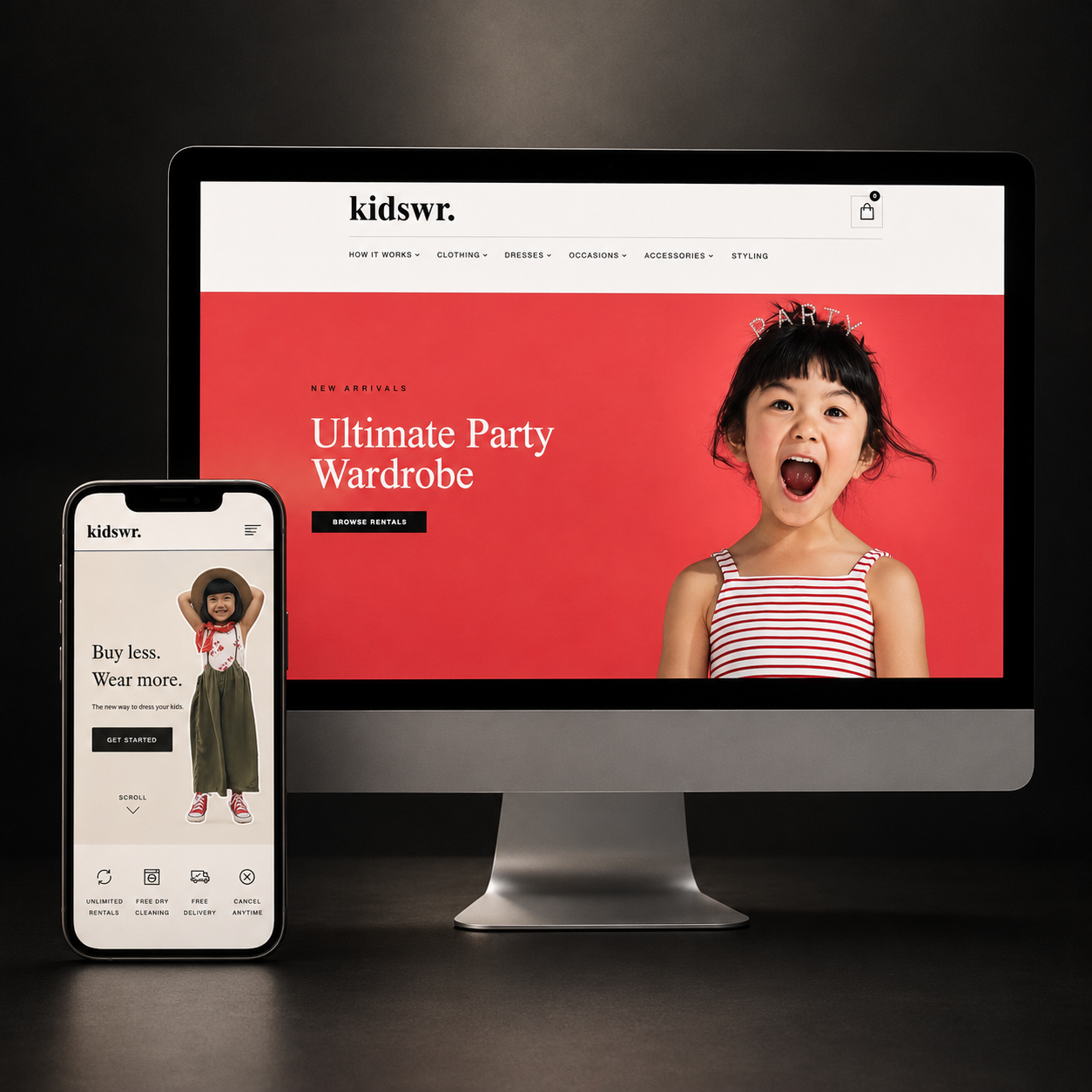
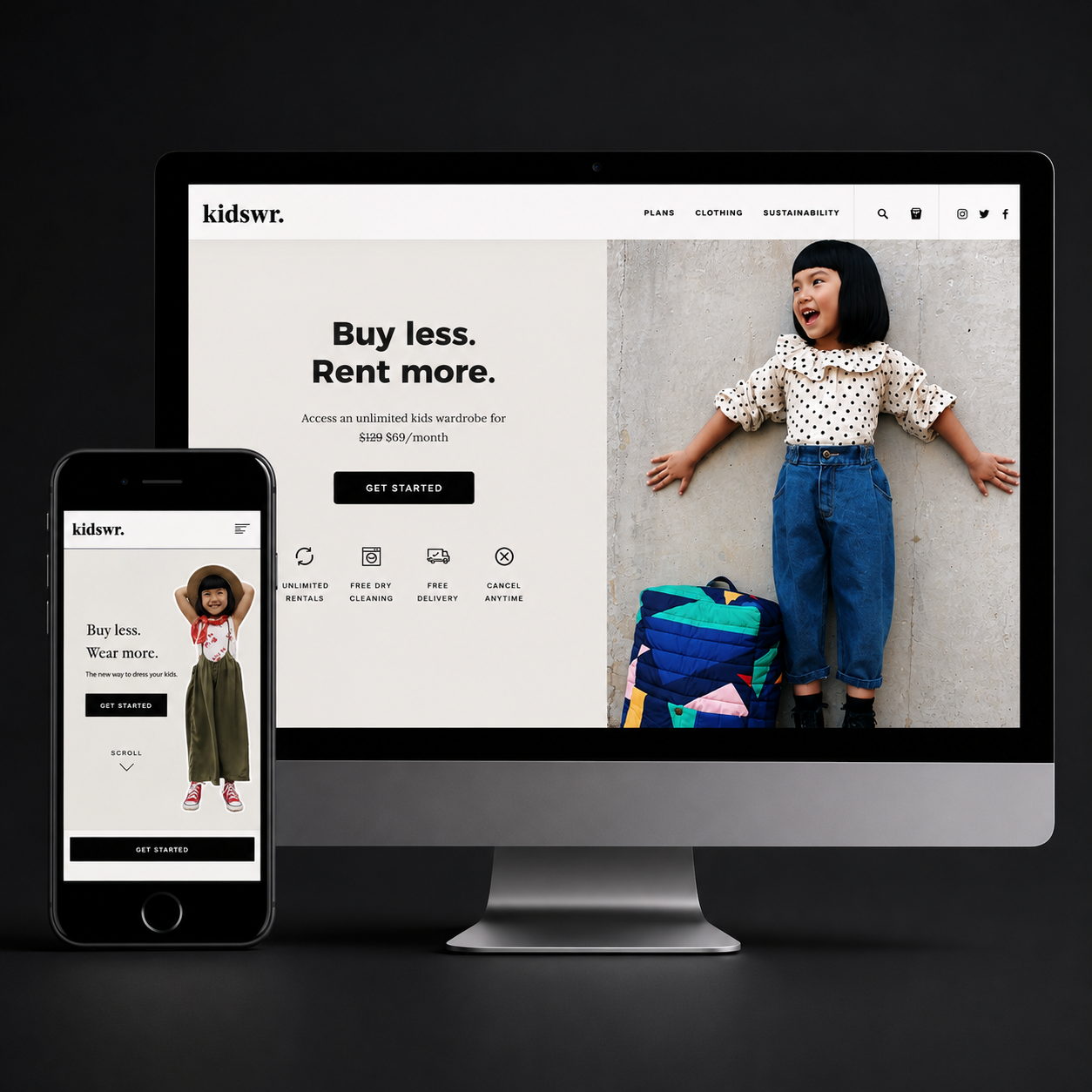
Brand and website redesign — trust-forward identity built for modern parents and investor presentations
Custom infrastructure for
a complex rental model.
Subscription clothing rental is operationally complex in ways off-the-shelf e-commerce platforms can't handle: real-time inventory states, rental periods, return tracking, subscription tier management, and hygiene-cycle logging all running simultaneously. A custom backend was the only viable path.
The technical build turned the platform from a concept into a functional, scalable operational infrastructure — while the UX turned the trust work from strategy into something users experienced the moment they landed.
15 LOIs before
the platform launched.
A rental platform's value proposition lives or dies on the quality of its inventory. Securing premium brand partnerships wasn't a post-launch growth task — it was a pre-launch proof point that the business model was viable for the brands it needed to supply it.
Proactively securing 15 Letters of Intent from premium children's clothing brands before launch validated the supply chain, elevated the brand's positioning with parents, and gave investors a concrete signal: the hard part of the model had already been solved.
"15 LOIs secured before launch — turning supply chain risk from the model's biggest liability into one of its clearest investor proof points."
18,400 followers.
No paid media.
Investor confidence in a consumer brand requires proof that real people want the thing — not just projected TAM and focus group data. Building an organic community of over 18,400 Instagram followers before the platform launched was deliberate: it turned a growth metric into an investor asset.
The strategy was entirely brand storytelling and collaborations with no paid amplification. The result was a community that proved the brand could scale without a heavy reliance on paid media, which is precisely what investors and future brand partners needed to see.
Every proof point
built before the ask.
The investor pitch wasn't a vision deck — it was a documented system. By the time the pitch was built, every major risk inherent to the model had been addressed with evidence: consumer demand validated, supply chain secured, technology architected, and organic traction demonstrated.
The pitch deck synthesized all of it into a clear narrative: the hard problems were already solved. What investors were being asked to fund was scale, not proof of concept.
| Investor Concern | Proof Point Built |
|---|---|
| Consumer Trust | Focus group research, brand identity designed to address hygiene and convenience objections, trust integrated into UX at every friction point |
| Supply Chain Risk | 15 LOIs from premium children's clothing brands — supply secured before launch |
| Demand Validation | 18,400+ organic Instagram followers, waitlist built pre-launch, no paid media spend |
| Technical Viability | Custom rental engine built — real-time inventory, subscription tiers, returns management operational |
| Organic Scalability | Community growth proof that the brand could scale without paid media dependency |
| Market Position | Model sufficiently validated that established competitors adopted similar subscription logic |
"The model was so successful it inspired the largest competitor to adopt similar subscription logic, validating kidswr. as a market disruptor before a single funding round closed."
From concept to
category leader.
kidswr. is the proof that a complex, high-friction business model can be de-risked through rigorous strategy. Every decision from brand identity to technical architecture to supply chain outreach was made in service of one goal: make the model undeniable.
The result was a platform that wasn't just investor-ready — it was a blueprint that competitors studied. When established players in children's fashion began adopting subscription rental logic, kidswr. had already done the work that proved it was worth doing.